The short answer
From January 1 to December 25, 2026 is 358 days. That is the standard count: subtract the start date from the end date and don’t count the end date. If you count both the first and the last day, the same span is 359 days. The two methods always differ by exactly one.
Exclusive vs inclusive counting
- Exclusive (end date not counted): the number of midnights between the two dates. Use it for countdowns, notice periods, payment terms and return windows. From Monday to the next Monday is 7 days.
- Inclusive (both dates counted): the number of calendar days you touch. Use it for the length of a trip, a hotel stay, a leave request or a course that runs “from the 1st to the 5th”. Those five days are 5 days inclusive, but only 4 exclusive.
When a contract or form says “within 30 days”, check whether the day it starts counts. If it doesn’t say, the exclusive count is the common default, but the wording of the document wins.
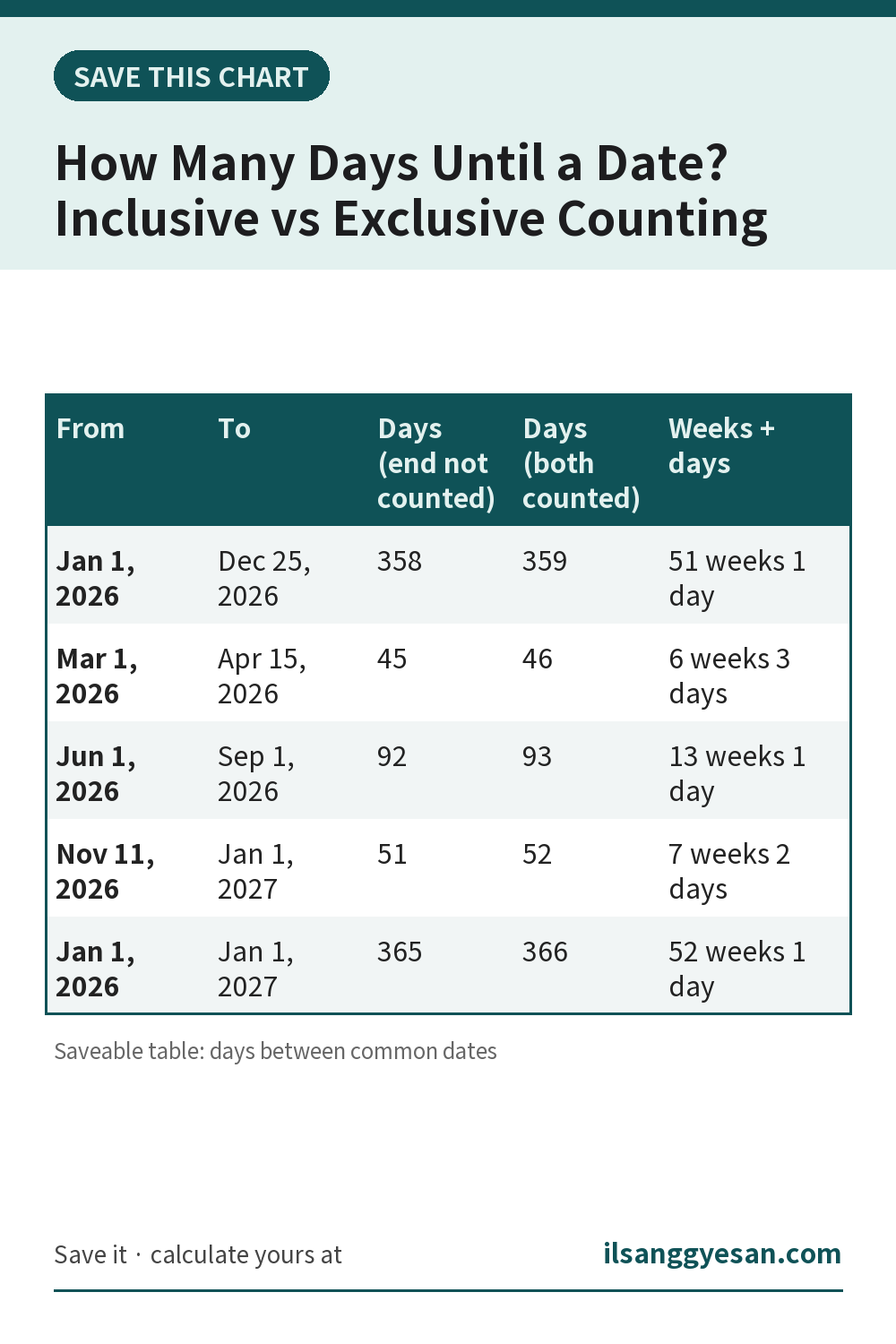
Saveable table: days between common dates
These examples use 2026 dates. Weekdays are Monday to Friday, with public holidays not removed.
| From | To | Days (end not counted) | Days (both counted) | Weeks + days | Weekdays |
|---|---|---|---|---|---|
| Jan 1, 2026 | Dec 25, 2026 | 358 | 359 | 51 weeks 1 day | 256 |
| Mar 1, 2026 | Apr 15, 2026 | 45 | 46 | 6 weeks 3 days | 32 |
| Jun 1, 2026 | Sep 1, 2026 | 92 | 93 | 13 weeks 1 day | 66 |
| Nov 11, 2026 | Jan 1, 2027 | 51 | 52 | 7 weeks 2 days | 37 |
| Jan 1, 2026 | Jan 1, 2027 | 365 | 366 | 52 weeks 1 day | 261 |
The weekday column counts Monday to Friday from the start date up to, but not including, the end date.
What date is 30, 60 or 90 days from now?
Adding days works the same way: the start date is day 0. Counting from November 11, 2026:
| Add | Resulting date |
|---|---|
| 14 days | Wed, Nov 25, 2026 |
| 30 days | Fri, Dec 11, 2026 |
| 60 days | Sun, Jan 10, 2027 |
| 90 days | Tue, Feb 9, 2027 |
| 180 days | Mon, May 10, 2027 |
| 365 days | Thu, Nov 11, 2027 |
Notice that 60 days lands on a Sunday. If a deadline falls on a weekend or holiday, some organizations move it to the next business day, but that depends on the rule, so check it rather than assuming.
Tips to avoid off-by-one mistakes
- Decide first whether the start day counts, then stay consistent.
- Write the weeks-and-days form (like 51 weeks 1 day) when you need a sanity check. Dividing by 7 and looking at the remainder catches many typos.
- Remember month lengths differ. February 1 to March 1, 2026 is 28 days, while June 1 to September 1 is 92.
- For ages, use a calculator built for it. The age calculator handles birthdays and leap years for you.
Enter your own two dates, or a number of days to add, in the days between dates calculator. It has a checkbox for including the end date.
As of November 11, 2026. Figures computed with the Gregorian calendar and checked against the site’s calculator logic.